


Every bed on one board, in Grid, List, Wall or Map, with a profile for the wall screen
ICU Module
The Eruntar ICU Module is a critical care information system: a live command centre for the unit, one workspace per bed, vendor-neutral device integration, NEWS2 and qSOFA early warning scores, protocol order sets and signed handover.
The AI advises. The clinician decides. And an alarm nobody answers escalates on its own.
12
kinds of ICU, configured per unit
18
clinical domains in one bed workspace
22
protocol bundles that activate as signed orders
10/30/60
minutes before an unanswered alert climbs
ICU Module
Solutions
Who it is for
Intensive care units, adult and paediatric
Works with
Our Doctor and Nurse Modules, or the systems you already use
The board
Every bed, live. Pushed, not polled
Early warning
NEWS2, qSOFA, MEWS and Shock Index, from the monitor
Orders
22 protocol bundles, signed before they run
An alarm
Acknowledged before it can be closed
The record
Append-only, and the database enforces it
Who sees a chart
The bedside team. Anyone else breaks glass, with a reason
Connects to
FHIR R4, HL7 v2 and any device gateway
Availability
In any browser
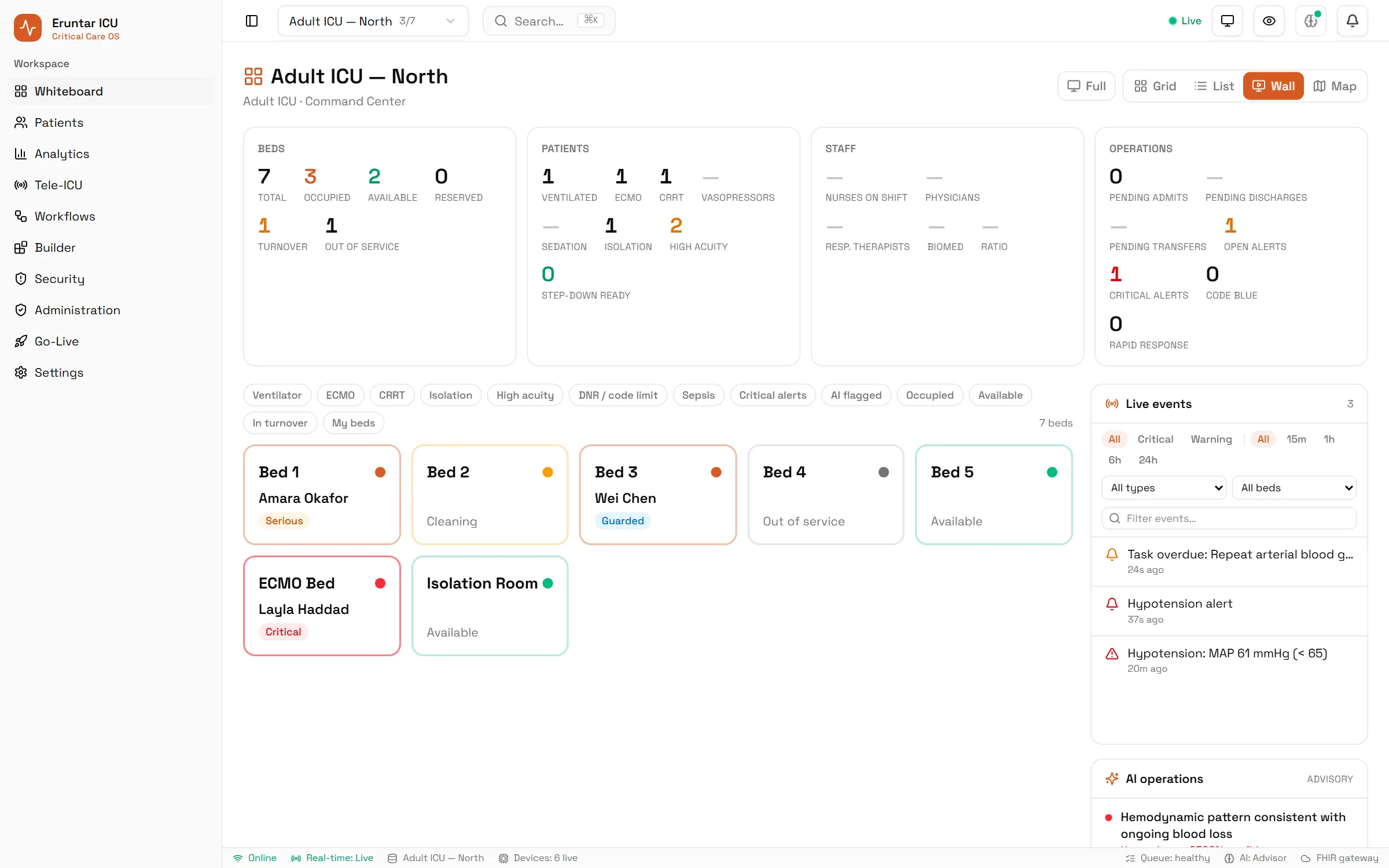
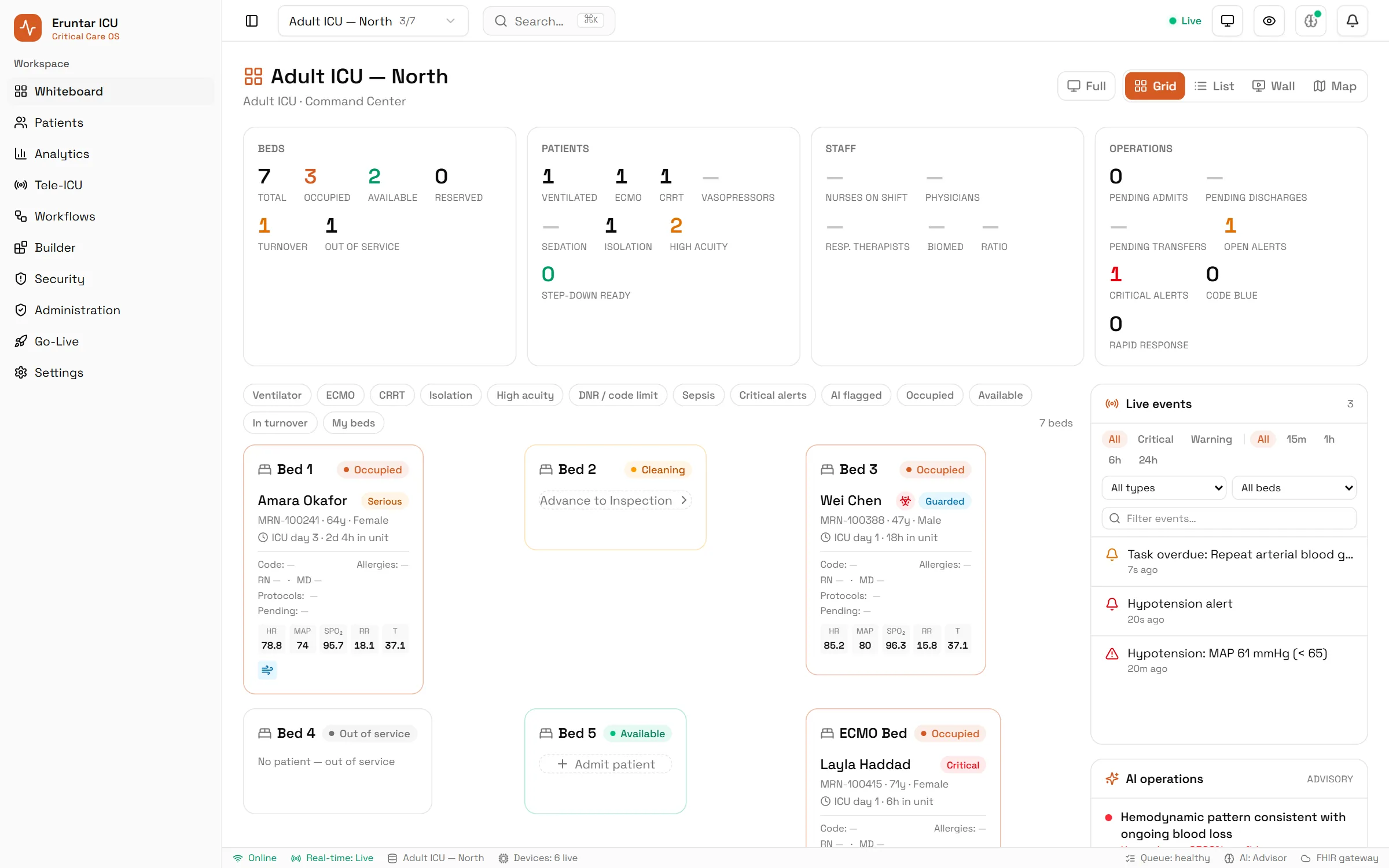
The command centre: every bed, every device, every open alert on one live board, with the staffing and capacity beside it.
Open a bed in rounding mode. The morning brief, the problem list, 24 hours of trends and the note editor, side by side.
Vitals arrive from the monitor. The scores recompute on every entry, and the alert, if one is needed, follows on its own.
A critical alert switches the workspace to crisis mode. One action opens a resuscitation timeline with rapid vitals entry.
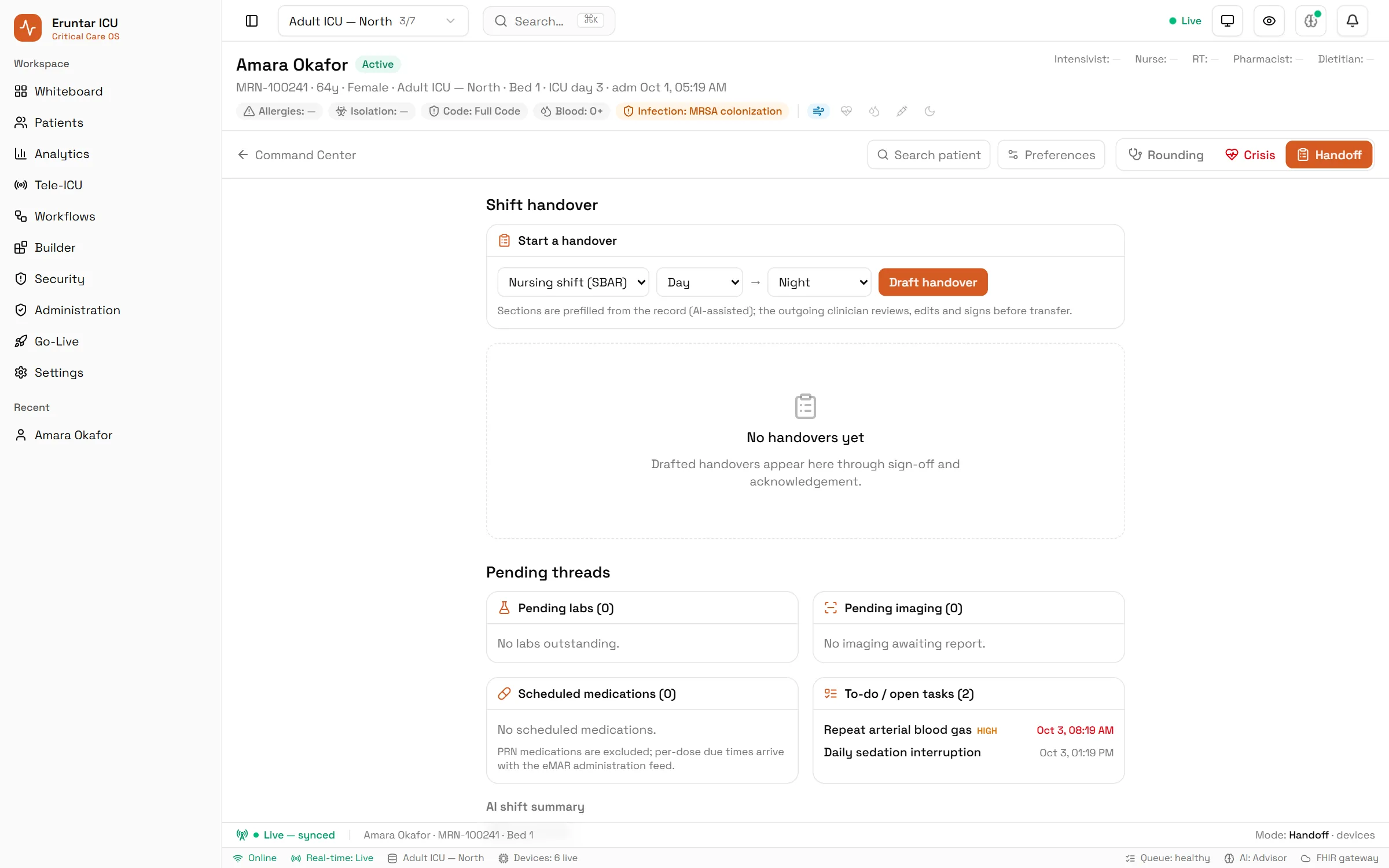
Handoff mode gathers pending results, unreported imaging and open tasks beside the SBAR, signed by you and acknowledged by the next clinician.
The module, screen by screen
See how the module looks at the bedside and across the unit: live devices, vitals, emergencies, analytics and the Tele-ICU worklist, each one a click from the board.
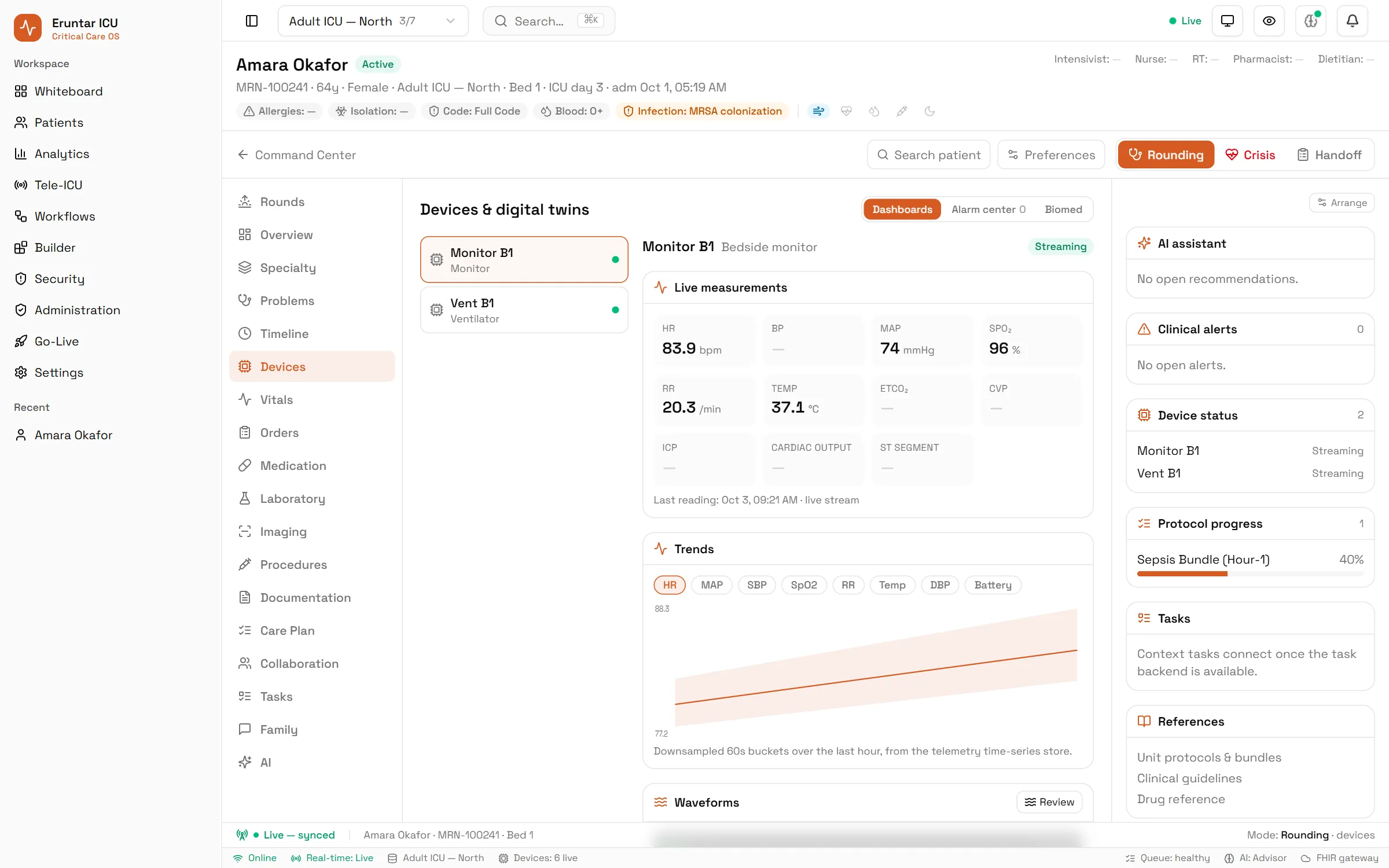
Each bed shows its connected devices as digital twins with live measurements, a trend over the window you choose, and a waveform review. A monitor that stops talking is marked disconnected after two minutes.
The handover
The handover workspace drafts an SBAR for the shift change, and gathers what the next clinician needs beside it: pending labs, unreported imaging, scheduled medicines and open tasks. The outgoing clinician signs it and the incoming one acknowledges it.
The clinical floor
An intensive care unit runs on judgement under pressure. These are the places where this system will not take that judgement away from the person holding it, and will not let it be skipped either.
At every autonomy setting, a clinical order needs a person to authorise it. The AI reaches patient data only through governed tools with their own access checks, and a denied request is recorded.
Every figure in a generated answer has to appear in the retrieved chart, rules or telemetry. If it does not, the answer is not shown.
Controlled medicines, blood products and ventilator changes need a second user to co-sign, and nobody can witness themselves.
Access is granted, not blocked, but only with a stated reason, for a limited time, with a banner on screen and a review afterwards by someone else.
An alert has to be acknowledged before it can be resolved, and a critical alert nobody answers climbs the escalation chain on its own timer.
This one is advisory. The clinician can proceed, but has to say why, and the reason stays with the order.
Orders, medicines, care plans, protocols and ventilator settings are never merged automatically. They wait for a clinician to decide.
And while the unit is running
An alert nobody answers goes to the charge nurse at ten minutes, the intensivist at thirty and the medical director at sixty. The chain is configuration, so a unit can set its own.
Devices are checked every thirty seconds. Two minutes of silence marks a device disconnected, and ten minutes raises a clinical alert at that bed.
The audit log is append-only and the database itself refuses updates and deletes to it. Configuration changes need an approver who is not the author, with an electronic signature.
Every recommendation carries its confidence, its evidence and when it was made. The AI never submits a clinical order, an organisation-level policy governs what it may produce, and each suggestion is accepted, rejected or overridden by a person, with the decision recorded.
A rounding brief drafted from the live record, and plain-language family updates, each reviewed and released by a clinician.
Questions answered by structured retrieval over the chart, the rules and the telemetry. A number that is not in the evidence is not in the answer.
Autonomous surveillance for seven syndrome patterns, sepsis among them, sweeping every two minutes. Every recommendation is accepted, rejected or overridden by a person.
Questions
It is a critical care information system, also called a patient data management system, for hospital intensive care units. It covers the unit board and capacity, a clinical workspace for every bed, continuous vitals and device data, early warning scores, orders and protocol bundles, documentation, signed handover and unit-level alerting.
A general record documents encounters. Intensive care produces data at a different density: vitals every few seconds, minute-level flowsheets, device alarms and unit operations. The ICU Module is built for that. Its interface is organised by bed and its data model by patient, and every clinical view draws from one timeline per patient.
Either. Attending and allergy context comes from the Doctor Module, staffing from the Nurse Module and released results from the Laboratory Module when they are installed. Without them it reads and writes FHIR R4 resources, accepts HL7 v2 admissions and results, and takes device telemetry through a vendor-neutral gateway.
Yes. Device data comes in through a telemetry gateway that is not tied to any one monitor vendor. A monitor that goes quiet is marked disconnected after two minutes and raises a clinical alert after ten, so a silent drop-off at a bed is never mistaken for a stable patient.
NEWS2, qSOFA, MEWS and Shock Index, computed from the monitored vitals by a deterministic rules engine rather than a model. Every input is traceable. A governed hourly NEWS2 sweep raises an alert and a nursing task when a patient reaches the trigger. Assessment-based scores that need a nursing or neurological examination are not computed by the module.
Every vitals entry is evaluated against the clinical rules. A critical alert has to be acknowledged before it can be resolved, and one that nobody answers climbs on a timer: the charge nurse at ten minutes, the intensivist at thirty, the medical director at sixty. The chain is configuration, not code, so a unit can set its own.
Yes. Twelve specialty configuration packs, from adult medical and surgical units through trauma, neuro, burns, paediatric and neonatal to high dependency, step-down and isolation, adapt the workspace, documentation templates, order sets and score sets per unit. One platform, configured per specialty rather than forked.
The bed workspace has a handoff mode that gathers what the next clinician needs beside the SBAR draft: pending results, unreported imaging, scheduled medicines and open tasks. The outgoing clinician signs it and the incoming one acknowledges it, so nothing is handed over from memory.
The AI advises and the clinician decides. It never submits a clinical order, and it reaches patient data only through governed tools with their own access checks. A number that does not appear in the retrieved evidence causes the answer to be rejected rather than shown. Every recommendation carries its confidence and evidence, and each one is accepted, rejected or overridden by a person, with the decision recorded.
The team looking after that bed. Anyone else has to break the glass with a stated reason. That access is time-limited, visible on screen while it lasts, and reviewed afterwards by someone other than the person who used it. Access is never blocked in an emergency, and accountability is never bypassed.
No. The audit log is append-only and the database itself refuses updates and deletes to it. Controlled medicines, blood products and ventilator changes need a second person to witness them, and nobody can witness their own action.
As a single Enterprise plan, quoted for your organisation by the number of beds and the kinds of unit you run. Nothing is held back for a higher tier because there is no higher tier: the unit board, the bed workspace, device streaming, protocols, the clinician-supervised AI, autonomous surveillance and the Tele-ICU cockpit are all included. Onboarding support comes with it. Book a demo through the form on this page.
What is included
The ICU Module is sold as a single Enterprise plan, quoted for your organisation. There is no ladder to climb, so every capability on this page is included, the AI and the surveillance among them. Pricing is quoted for the number of beds and the kinds of unit you run.
Beds & units per agreement
Quoted for the number of beds and the kinds of unit you run.
Talk to usNeed help sizing it, or running several units? Talk to our team.
A working session rather than a slide deck: your beds, your units, your monitors. Tell us how many beds you run and which kinds of unit you have, and we will take it from there.
Running the wards as well? Explore the Nurse Module.