

The bed board shows who is where, and what they are isolated for
Nurse Module
The Eruntar Nurse Module is one workstation for the whole shift: an eMAR with barcode medication administration, NEWS2 early warning scores, nursing tasks and signed SBAR handover.
Unsafe doses are blocked, not just flagged, and what it does not know, it tells you.
5
rights checked before every dose
~70
high-alert drugs that need a second nurse
90s
how often it looks for a missed dose
15/30/60
minutes before an unread handover is chased
Nurse Module
Solutions
Who it is for
Nurses on hospital wards
Works with
Our Doctor Module, or the system you already use
Every dose
Scanned, and checked against the doctor's order
Risky drugs
A second nurse has to check
Early warning
NEWS2, scored as you chart
Handover
Signed, and chased until it is read
The record
Nothing can be quietly changed
Who sees a chart
Assigned nurses. Anyone else leaves a reason
Connects to
FHIR, HL7 and openEHR
Availability
Generally available, in any browser
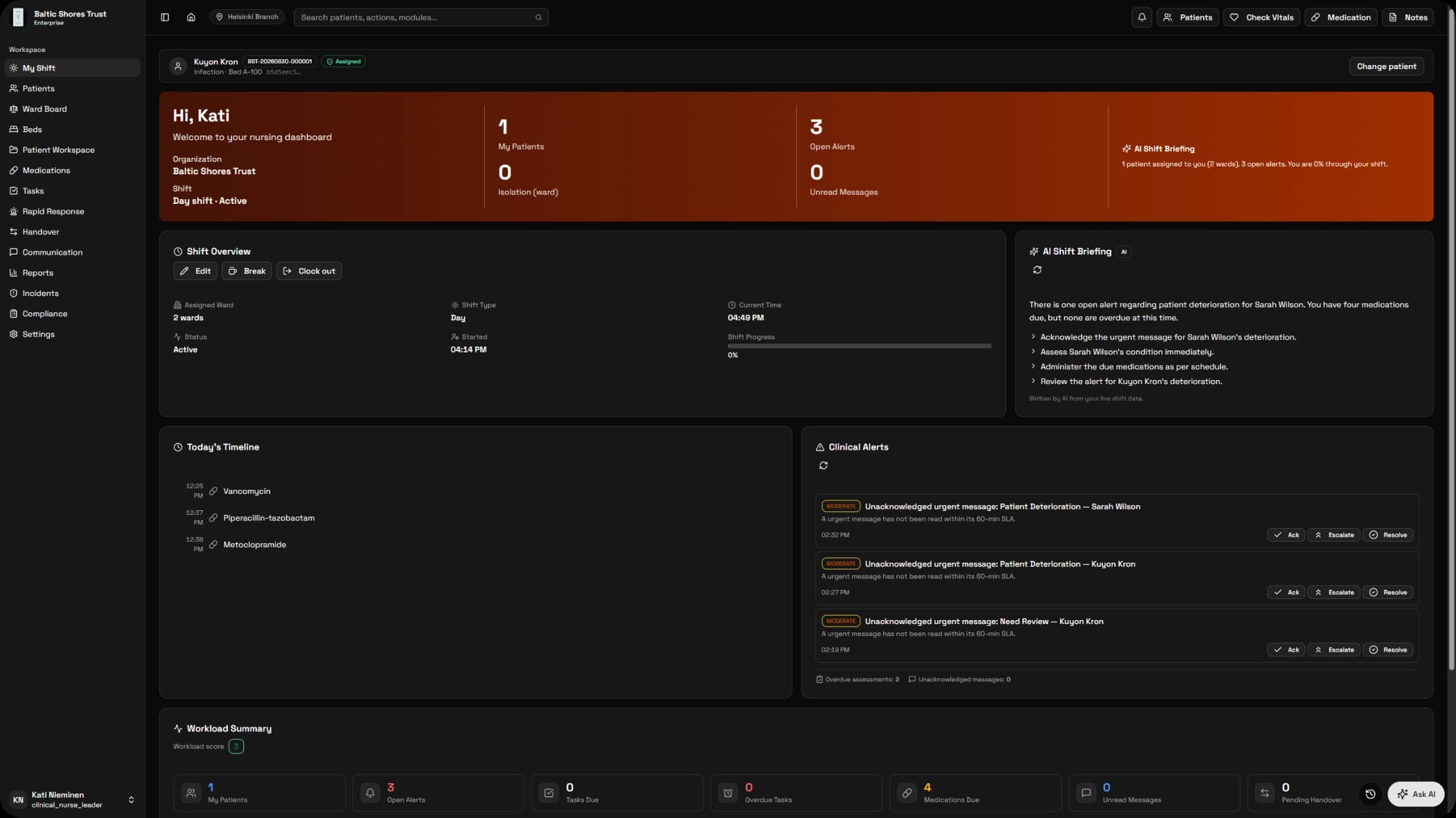
Clock in and see who needs you first: open alerts, medicines due, and what changed overnight.
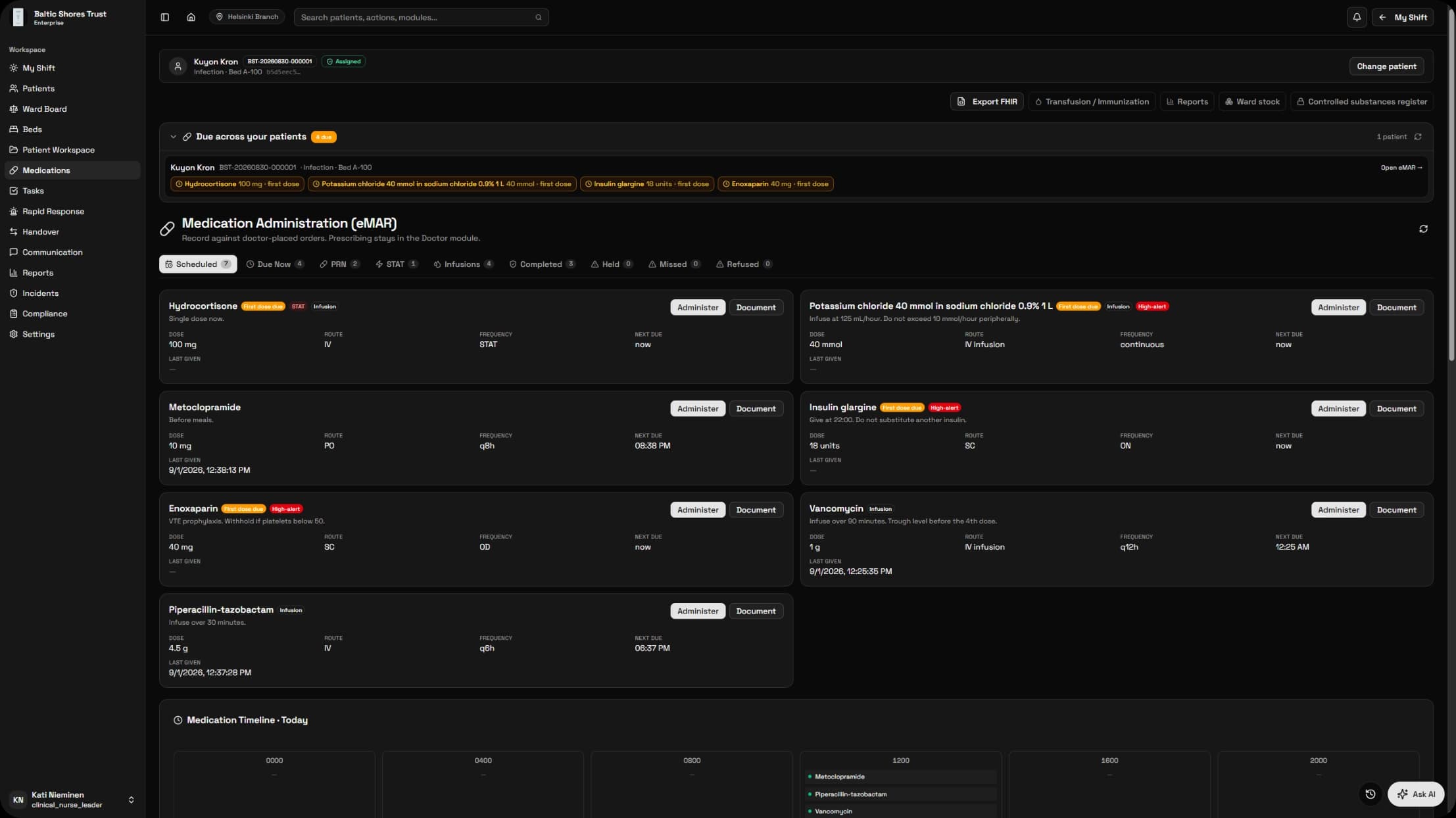
Scan the wristband and the label. The doctor's order is re-checked before the dose is recorded.
Chart the observations once. The early warning score, and the alert if one is needed, follow on their own.
Wounds, fluids, lines and notes, recorded where the care happens instead of from memory at the desk.
A signed handover, drafted from the shift itself, that the next nurse has to acknowledge.
Medication safety
Most systems put a banner in front of a nurse and let her click past it. These are the situations where this one simply will not record the dose.
Unknown is not the same as none. A lesser system shows an empty list, which reads like a clinical negative.
With the order feed unreachable the dose is refused, not waved through. In production this cannot be switched off.
A dose limit per kilogram, with no weight to apply it to, is not a calculation anyone should be asked to eyeball.
The drug is classified by the server, so the check cannot be skipped by leaving a box unticked, and nobody can witness themselves.
A dose that far over is usually a misplaced decimal point, so it says so rather than offering an override.
A discrepancy raises a critical alert naming it as a possible diversion, rather than quietly adjusting the balance.
And once the dose is given
Signing re-checks your PIN. A correction is a new signed entry pointing at the original, saying why it was wrong.
An opioid schedules a respiratory check. Insulin schedules a glucose recheck. Nobody has to hold it in their head.
The record is recomputed every 90 seconds, so an overdue dose escalates before anyone notices it was missed.
Eruntar's AI summarizes and prioritizes from real, live data. The facts are always deterministic; the AI never invents a clinical value or overrides a safety check, and every AI output is logged for review.
A start-of-shift summary with a prioritized focus list, built from live data about your patients, never invented.
Bedside advisory notes on the drug you're giving: what to monitor, precautions, patient education. Advisory only, always labeled.
Auto-drafted handover summaries and flags for tasks at risk of being missed across the ward.
Questions
It is ward and bedside nursing software for hospital inpatient units. It covers medication administration (eMAR) with barcode verification at the bedside, observations with NEWS2 early warning scores, nursing tasks, signed SBAR shift handover, infection prevention and control, and incident reporting.
Either. It runs alongside the Eruntar Doctor Module, or against a third-party EHR through FHIR R4, HL7 v2 or openEHR, or a custom adapter. Which source a hospital uses is configuration rather than a code change, so two organisations on one deployment can sit behind different systems.
Before a dose can be recorded, the system re-fetches the doctor's live order and compares patient, drug, dose and route itself. Dose is compared as a dose, so 0.5 g passes against an ordered 500 mg and 501 mg does not. The nurse scans the patient's wristband and the medication label. High-alert drugs require a second nurse to check independently, and nobody can witness themselves.
Not the hard ones. If the allergy status is unknown, or the doctor's order cannot be verified, the dose is blocked rather than flagged, and in production those two interlocks cannot be switched off. Other checks are advisory and can be overridden, but only with a reason that is recorded.
NEWS2 for adults, recomputed on every vital-sign entry, which raises an alert and pushes the deterioration to the doctor when it reaches the published trigger. Patients under 16 are scored on the paediatric instrument automatically, on age ranges derived from date of birth. The result also states whether oxygen was assumed and how many of the core observations were actually measured, so a partial score is never shown as a complete one.
No. Medication administrations and clinical entries are append-only. A correction is a new signed entry that points at the original and has to say why the original was wrong. Every clinical change is sealed into a tamper-evident chain, and the system can be asked to verify that chain and report exactly where any break is.
The nurses assigned to that patient. Anyone else has to give a written reason to break the glass, and that access is time-limited, recorded and reviewable. Infection preventionists and auditors have a separate read-only scope, so their routine work does not drown the break-glass register.
No. It summarises and prioritises from live data, and the facts it works from are computed deterministically and shown alongside what it writes. Administering a medication or signing a note can never be automated at any setting. Where no AI service is configured, each feature falls back to a deterministic result and says which of the two produced it. Every AI action is logged for review.
Four monthly plans, priced by what a ward does rather than by seat count. Pulse covers the complete bedside record and every safety check for a small unit. Flow adds running the ward: beds, the roster, delegation and isolation, together with the AI assistant. Acuity adds the specialty units (theatre, burns, dialysis, maternity and emergency) and the quality and workload numbers. Continuum is for multi-site groups and is quoted. Every plan includes a bed and storage allowance; current prices are in the pricing section on this page.
Pricing
Not by seat count: a ward has more staff than beds across three shifts, and charging per login would price the night shift. Each plan includes a bed and storage allowance, and every plan carries the whole safety net: the interlocks, the second signature on a high-alert drug, NEWS2 and the audit trail are never something you upgrade to.
10 beds · 20 GB
Small nursing homes, day units and specialty clinics. The complete record and every safety check, deliberately manual.
20 beds · 60 GB
A community hospital ward. Everything needed to run a shift, and the pace that comes with it.
20 beds · 100 GB
Multi-specialty units and busy surgical wards. The specialty units and the numbers.
Beds & storage per agreement
Multi-site hospital groups. Sets the standard rather than reporting against one.
Tell us how many beds you run and which units you have, and we will tell you which plan fits and what it costs. If you are a multi-site group, that is a Continuum conversation and we will scope it with you.
Rather see the rest of the platform? Explore the Doctor Module.